
Key takeaways
- Every SMSF must have its annual return audited before it's lodged, and the auditor must be appointed at least 45 days before the due date.
- New funds and funds with overdue returns that prepare their own return are due 31 October 2026. Because that's a Saturday, they have until 2 November 2026.
- Most funds lodging through a registered tax agent have until 15 May 2027, provided earlier years are up to date.
- If a return is two weeks overdue, the fund's status on Super Fund Lookup can change. Employers are then told not to pay contributions to it, which matters more under Payday Super.
- Plan now for 2026–27: Division 296, the $2.1 million transfer balance cap and higher contribution caps.
Running a self-managed super fund means you are responsible for its compliance, including an independent audit and an annual return every year. With the 2025–26 year closed, now is the time to get your fund's records to your auditor and confirm your lodgment date.
Here is what's due, what your auditor will ask for, and why late lodgment has bigger consequences than it used to.
When your SMSF annual return is due
| Your fund | 2025–26 return due |
|---|---|
| New fund, or a fund with overdue returns, preparing its own return | 2 November 2026 (31 October is a Saturday) |
| Newly registered fund lodging through a tax agent | 28 February 2027 |
| Most funds lodging through a tax agent, with earlier years up to date | 15 May 2027 |
Your exact date depends on your fund's history and how it lodges, so check it with your tax agent. If earlier returns are outstanding, an earlier date usually applies.
The SMSF annual return reports the fund's income tax, its regulatory information and member contributions, and it is used to pay the annual ATO supervisory levy.
The audit comes first
An approved SMSF auditor must audit the fund's financial statements and its compliance with super law before you lodge. Trustees must appoint the auditor at least 45 days before the lodgment due date. Leave it too late and you risk missing your deadline altogether.
The auditor checks things like whether investments are held in the fund's name, valued at market value, made under a current investment strategy, and dealt with on arm's-length terms. Any breaches can be reported to the ATO.
What to prepare for your auditor
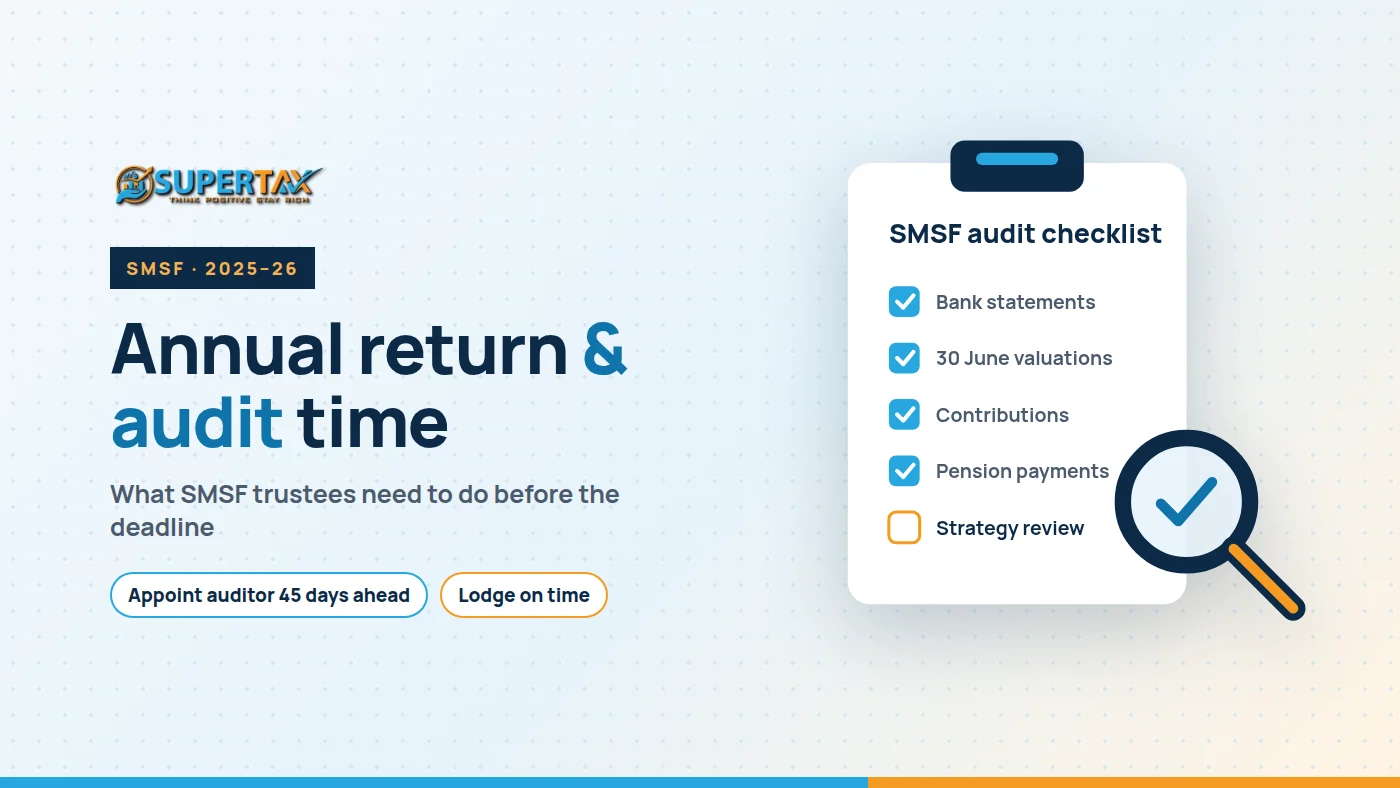
- bank statements for every fund account to 30 June 2026
- investment statements and market valuations at 30 June 2026, including property and unlisted assets
- contribution details for each member, including employer contributions and personal contributions claimed as deductions
- pension records, including proof that minimum pension payments were made
- your current investment strategy, and minutes showing it was reviewed
- trustee minutes and resolutions for major decisions during the year
- leases, loan agreements and other documents for any property or borrowing
Why lodging late matters more in 2026
If an SMSF annual return is two weeks overdue, the ATO can change the fund's status on Super Fund Lookup to "regulation details removed". When that happens:
- employers are told not to pay contributions to the fund, and may pay them to their default fund instead
- other funds may refuse rollovers into your SMSF
- penalties can apply, and the fund's tax concessions may be at risk
Under Payday Super, which started on 1 July 2026, employer contributions arrive with every pay run. A status change can now disrupt contributions within weeks, not just at the end of a quarter. Once you lodge, the status is usually restored within a couple of weeks.
Rules to plan for in 2026–27
- Division 296: extra tax applies to realised earnings for members with total super balances above $3 million, from 1 July 2026.
- Transfer balance cap: rose to $2.1 million on 1 July 2026.
- Contribution caps: $32,500 concessional and $130,000 non-concessional from 1 July 2026.
- Residential property: new borrowing (LRBAs) for residential property is no longer allowed. See our guide to the change.
Our 2026 SMSF changes guide covers these in more detail.
Trustee checklist
- Confirm your 2025–26 lodgment due date with your tax agent.
- Appoint your approved auditor at least 45 days before that date.
- Gather statements, valuations and contribution details to 30 June 2026.
- Check minimum pension payments were made, and contributions stayed within the caps.
- Review and minute your investment strategy.
- Lodge on time, and check your fund's status on Super Fund Lookup.
- Plan contributions and pensions for 2026–27 with the new caps and Division 296 in mind.
Supertax looks after SMSF accounting, audits and annual returns, and our principal is an SMSF Specialist Advisor. Learn more about our SMSF services, or book a free 15-minute consultation. Consultations are available in English, Punjabi (ਪੰਜਾਬੀ), Hindi (हिंदी), Urdu (اردو) and Gujarati (ગુજરાતી).
This article contains general information only and does not take your personal circumstances into account. Your fund's due date can differ depending on its history and lodgment arrangements. Speak with a registered tax agent or SMSF specialist before acting.
Need help with your SMSF?
Talk to a registered tax agent and SMSF Specialist Advisor at Supertax.